
You’ve heard the stories. The Italian who only dates for dinner. The German who texts once a week. The French woman who doesn’t believe in dating apps. Maybe you’ve even believed them. But here’s the truth: Eurodate myths are costing you real connections. Not because they’re completely false - but because they’re incomplete, outdated, or wildly exaggerated.
Let’s cut through the noise. If you’ve been holding back because you think Europeans are too cold, too complicated, or too "different," you’re missing out. And no, it’s not because you’re doing something wrong. It’s because you’ve been sold a fantasy.
Key Takeaways
- European dating isn’t one-size-fits-all - it varies wildly by country, city, and even neighborhood.
- "They don’t text"? That’s a myth. They just don’t text like Americans do.
- Being "too direct" isn’t rude - it’s efficient. And Europeans appreciate that.
- Online dating in Europe is huge - and not just for young people.
- "Eurodate" isn’t a culture. It’s dozens of cultures, each with their own rules.
What You Think You Know About Eurodate (And Why It’s Wrong)
Let’s start with the biggest myth: "Europeans are cold." You’ve probably heard this from someone who dated a Swede for three weeks and then got ghosted. Or from a friend who met a Spaniard on vacation and swore they were "emotionally unavailable."
Here’s what actually happens: Europeans often take time to build trust. That doesn’t mean they’re cold. It means they’re cautious. In countries like Germany, the Netherlands, or Scandinavia, emotional openness comes after shared experiences - not after three dates. You don’t text "good morning" because you’re in love. You text because you’re meeting for coffee later that day.
Another myth? "They don’t use dating apps." Wrong. Tinder, Bumble, and even local apps like Mamba (popular in Eastern Europe) are used by millions. In cities like Berlin, Prague, or Barcelona, over 60% of people aged 25-40 use dating apps regularly. The difference? People use them to find real connections - not just hookups.
And then there’s the "French woman doesn’t like to talk about feelings" stereotype. Sure, some French people are private. But so are some Americans. The difference? French culture values subtlety over performative emotion. You won’t get a long monologue about your "vibes." But you’ll get a quiet gesture - a shared bottle of wine, a walk without a destination, a text that says "I thought of you today."
Why Eurodate Feels Different (And Why That’s Good)
Think of dating in Europe like public transportation. In the U.S., you’re often expected to jump into a full-service experience: dinner, drinks, a movie, a hug, a text the next day. In Europe? You get the bus. Sometimes you take it alone. Sometimes you wait for someone to join you. Sometimes you don’t even know where you’re going until you get there.
That’s not weird. That’s efficient. Europeans tend to value authenticity over performance. A date isn’t a performance review. It’s a chance to see if you vibe - not if you can impress.
Take the UK. You might think British people are reserved. But in Manchester, London, or Glasgow, you’ll find people who are deeply emotional - they just don’t say "I love you" after two weeks. They say it when they start doing your laundry. Or when they remember how you take your tea.
And in Poland? It’s common to meet someone at a local market, chat over pierogi, and then plan a weekend trip to the mountains. No apps. No pressure. Just real life.
How Europeans Actually Date (Spoiler: It’s Not What You Think)
Let’s break down what dating really looks like across Europe - not the myths, but the reality.
- Germany: Punctuality matters. Being late is rude. Dates are often planned days in advance. You’ll get a clear message: "Saw you liked that book. Want to grab coffee Saturday?" No games. No mixed signals.
- Italy: Yes, they love food. But they also love deep conversations. A date might start at a bar, move to a park, and end at a gelato shop at midnight. It’s not about romance - it’s about connection.
- Spain: Nights are long. Dates often start after 9 p.m. and last until 2 a.m. You’ll find people chatting over wine, not just flirting. The goal isn’t to get to "next level" - it’s to enjoy the moment.
- Scandinavia: Equality is key. Splitting the bill isn’t a test - it’s normal. You won’t be expected to "lead" the date. You’ll be expected to show up as yourself.
- Eastern Europe (Poland, Czechia, Romania): Family matters. You might meet their parents early. It’s not a trap - it’s a sign they’re serious.
There’s no single "European way." But there is a common thread: realness over ritual.
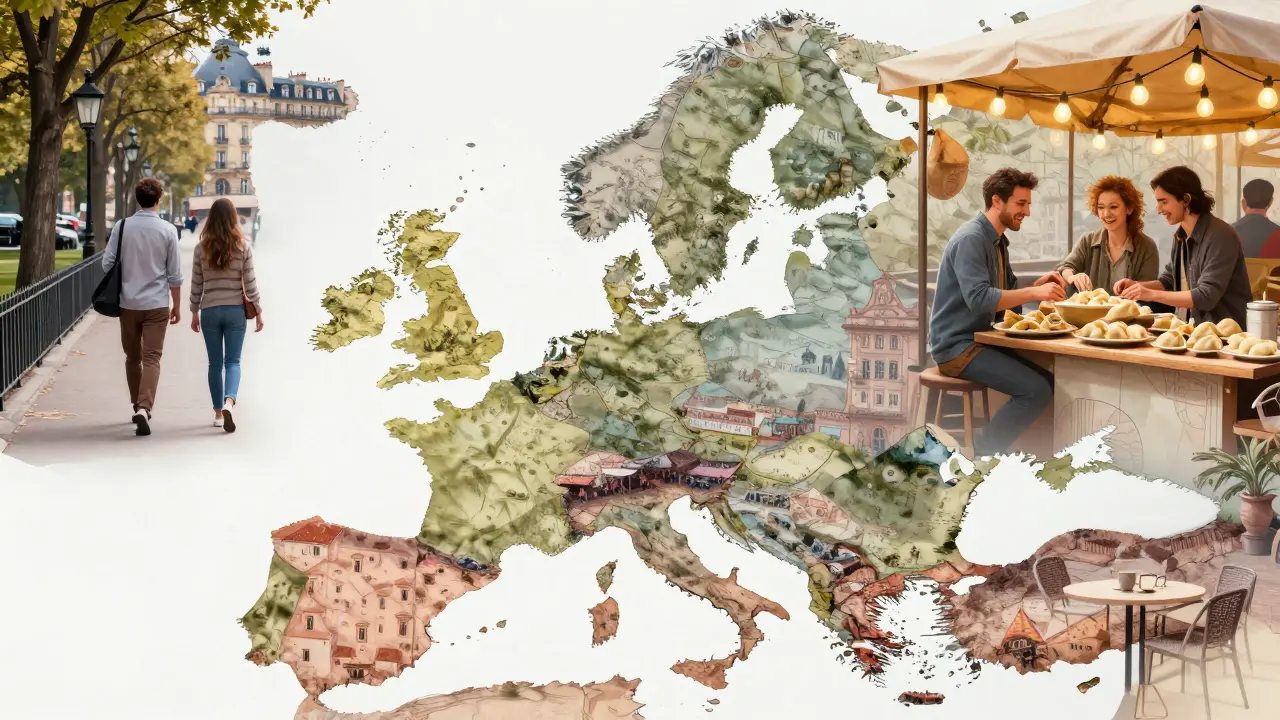
Why These Myths Exist (And How to Stop Believing Them)
These myths didn’t come from nowhere. They come from:
- Travelers who met one person and generalized
- Romantic comedies that show French people kissing on balconies and Germans being robotic
- Online forums where people vent about bad dates
But here’s what you’re not hearing: the 90% of Europeans who are just trying to find someone to talk to, laugh with, and maybe share a quiet Sunday morning with.
Stop comparing European dating to American dating. It’s not better or worse. It’s different. And that’s okay.
What to Expect on Your First Eurodate
If you’re nervous about your first date in Europe, here’s what actually happens:
- You’ll likely meet in a café, bar, or park - not a fancy restaurant.
- There won’t be a script. You might talk about work, politics, or that weird dream you had.
- They won’t ask if you "like them." They’ll ask if you want to see them again.
- You might not hold hands. That’s fine. Physical closeness comes later - if it’s real.
- They might not say "I had a great time." They’ll say, "Let’s do this again."
That’s it. No pressure. No performance. Just two people seeing if they fit.
How to Navigate Eurodate Without the Myths
Here’s how to stop letting myths hold you back:
- Don’t assume. Ask. If you’re unsure about their expectations, just say: "How do you usually date?" Most people appreciate the honesty.
- Be yourself. Europeans respond to authenticity, not charm. If you’re awkward, be awkward. If you’re quiet, be quiet. That’s more attractive than pretending.
- Don’t overthink texts. If they don’t reply for two days? They’re probably busy. Not avoiding you.
- Meet in public places. First dates are rarely at home. Parks, cafes, museums - these are the norm.
- Watch for actions, not words. A European who remembers your coffee order, walks you home, or invites you to a local festival? That’s real interest.
Eurodate vs. American Dating: A Quick Comparison
| Aspect | Eurodate | American Dating |
|---|---|---|
| First Date Location | Café, park, market, museum | Restaurant, bar |
| Texting Frequency | Low to moderate - only when planning | High - daily check-ins |
| Physical Affection (Early) | Minimal - hand-holding may come after weeks | Common - hugs, kisses by second date |
| Meeting Family | Early - sometimes within first month | Later - often after 3+ months |
| App Usage | Very common - used for serious relationships | Common - often for hookups |
| "I like you" Timing | Weeks to months - based on consistency | Days to weeks - often after first date |
Frequently Asked Questions
Do Europeans really not like dating apps?
No - that’s a myth. Dating apps are widely used across Europe, especially in cities like Berlin, Madrid, and Warsaw. People use them to find serious relationships, not just hookups. In fact, 47% of Europeans aged 18-35 have met a partner through an app, according to a 2024 EU survey.
Why do Europeans seem so distant at first?
It’s not about being cold - it’s about being careful. Many Europeans prioritize emotional safety. They don’t want to rush into vulnerability. That doesn’t mean they don’t feel deeply - it means they show it slowly. A shared silence, a remembered detail, a quiet gesture - those are their love languages.
Is it true that French people don’t say "I love you"?
They say it - just not on schedule. French culture values patience. Saying "I love you" too early can feel cheap. It’s not about not feeling it - it’s about making sure it’s real. Many French people wait until they’ve shared a season: a winter, a trip, a crisis. That’s when the words mean something.
Should I change my behavior to fit European dating?
No - but be open to adaptation. You don’t need to become someone else. But if you’re used to constant texting or grand gestures, you’ll need to adjust your expectations. Europeans respond to consistency, not drama. Show up. Be honest. Listen. That’s all they ask for.
What’s the biggest mistake Americans make on Eurodates?
Trying to impress. Europeans don’t want a performance. They want a person. Don’t over-explain. Don’t rehearse lines. Don’t try to be funny. Just be present. The best dates are the ones where you forget you’re on a date.
Final Thought: Stop Myth-Busting. Start Connecting.
The truth about Eurodate isn’t in the stereotypes. It’s in the quiet moments: the shared umbrella in the rain, the late-night conversation over cheap wine, the way someone remembers your favorite snack. That’s where real connection happens.
You don’t need to change who you are. You just need to stop letting myths decide your next move. Europe isn’t a mystery. It’s just different. And different doesn’t mean broken. It means waiting for you - on your terms, in your time, with your own rhythm.


lee sphia
February 22, 2026 AT 01:11European dating norms aren't mystical. They're just less performative. I used to think silence meant disinterest until I spent a weekend in Berlin and realized the person beside me was fully present-no texts, no emojis, just listening. That’s not cold. That’s respect.
Stop measuring connection by response speed. Real chemistry doesn’t need a notification.
Emily Hutchis
February 22, 2026 AT 12:40I lived in Lisbon for a year. No one texted every day. But people showed up-with bread, with questions, with silence that didn’t feel empty. The myth isn’t that Europeans are distant-it’s that Americans confuse intensity with intimacy.
Love isn’t a DM thread. It’s the way someone notices you flinch at loud noises and moves your chair away from the speaker. That’s the real signal.
Jaime Rosenfeld
February 22, 2026 AT 13:14Let’s be real-this whole "Eurodate" thing is just woke propaganda dressed up as cultural insight. Americans are the only ones who still believe in romance. Europeans? They’re just too busy being efficient to care about your emotional labor.
And don’t even get me started on "splitting the bill"-that’s not equality, that’s just laziness disguised as feminism. You want connection? Pay for the date. Show you’re invested.
Also, why are we even talking about this? We have bigger problems than whether someone texts back after 48 hours. Get a job. Stop romanticizing European aloofness. It’s not deep-it’s just detached.
Sanjeev Tankariya
February 23, 2026 AT 08:20There is, perhaps, a deeper philosophical layer here: the Western obsession with explicitness as a measure of authenticity. In many European traditions, silence is not absence-it is presence. A shared glance across a café, the unspoken understanding that you both prefer rain over sunshine, the quiet act of holding the door without commentary-these are not failures of communication, but refinements of it.
Compare this to the American model, where every emotion must be verbalized, every intention must be confirmed, every feeling must be tagged with a hashtag. Is this clarity-or performance?
Perhaps the real divide is not between continents, but between those who seek validation through words, and those who find meaning in the spaces between them.
And yes, I’ve met Germans who cried during a movie, Italians who sent voice notes at 3 a.m., and Scandinavians who planned trips just to see you again. The myth is not in the behavior-it’s in the assumption that behavior must conform to expectation.
Anshu Chauhan
February 23, 2026 AT 10:18Actually, this article is misleading. Europeans aren’t more authentic-they’re just less expressive because their cultures suppress emotion. The French don’t say "I love you" because they’re emotionally stunted, not because they’re deep. The Germans are punctual because they’re rigid, not because they value efficiency.
And don’t get me started on the "family meeting early" thing-that’s not commitment, that’s control. You think Poland is romantic? They’re just desperate to marry you off before you turn 30.
Stop romanticizing repression. Real connection requires vulnerability. And Europeans? They’re not vulnerable-they’re just quiet.
Stan Alley
February 23, 2026 AT 10:33I’ve dated three Europeans. All of them ghosted me after two weeks. So much for "realness." This article is just woke propaganda for people who can’t handle rejection. If you’re not getting texts, you’re not a priority. Period.
Stop making excuses for flakiness. Europe isn’t mysterious-it’s just emotionally unavailable. And if you’re okay with that, maybe you’re the one who needs to change.
Beth Butler
February 23, 2026 AT 12:11I just want to say-this was so calming to read. I’ve been so anxious about dating in Europe because I thought I had to be someone else. But reading this made me realize I don’t need to perform. Just showing up as I am-quiet, a little awkward, always forgetting to text back-is enough.
Thank you for reminding me that connection doesn’t need fireworks. Sometimes, it’s just a shared umbrella and a quiet walk home.